

The Project
Project overview
Humberhead Solar would provide approximately 500 megawatts of clean, renewable energy, as well as battery storage facilities capable of storing electricity until it is needed, so that the UK can benefit from solar power, even beyond dusk and before dawn.
A project of this scale is expected to power approximately 255,000 homes, strengthening the resilience of the national energy system and increasing the supply of secure domestic power.
The operational life for Humberhead Solar will be up to 60 years. Land under and around the solar panels will be managed as grassland suitable for grazing. At the end of the project’s operational life, there will be a decommissioning plan. This will detail the removal of infrastructure and restoration of the land to its original use.
Humberhead Solar will deliver significant ecological benefits through habitat creation and enhancement measures, along with good land management through operation.
As the proposals would have a generating capacity over 100MW, they are therefore defined as a Nationally Significant Infrastructure Project (NSIP) under the Planning Act 2008. This requires an application for a Development Consent Order (DCO) to be submitted to the Planning Inspectorate and determined by the Secretary of State for the Department of Energy Security and Net Zero (DESNZ).
Key numbers

500 MW
Generating solar capacity

500 MW
BESS Capacity


255,000
Homes powered
Up to 60
years operational life
Click on the image above to open a large version in a new tab
The site
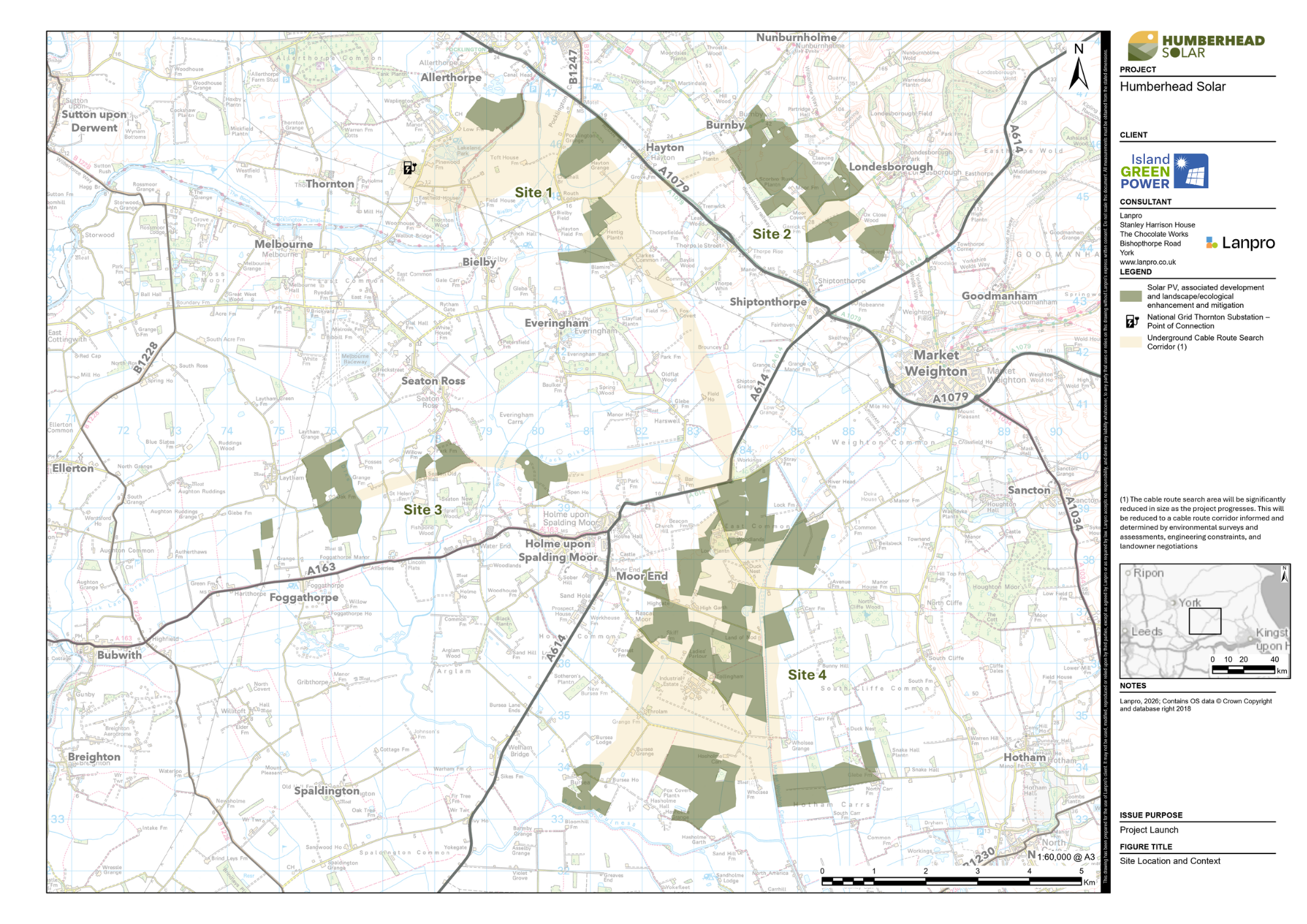
Humberhead Solar is proposed to be located on a number of sites in an area approximately 3km to the south-west of Market Weighton and 1km to the south-east of Pocklington.
The Sites are known as Sites 1, 2, 3 and 4 and each comprises a series of sub-sites. The Point of Connection for the project is at the existing National Grid Thornton Substation located approximately 1.36km to the south-west of the nearest site (Site 1).
The Sites comprise a total of approximately 1,595 ha (3,941 acres) of land. However, this will also include land set aside for landscaping and biodiversity mitigation and enhancement, local connectivity and access.
The Sites will be linked to each other and to the Thornton Substation via underground cables within a ‘Cable Route Corridor’. We will refine the route through environmental assessments, landowner negotiations and your consultation input. The Cable Route Corridor will therefore become significantly smaller as the project progresses.
Project Timeline
Below we have outlined some of the key milestones for the project. Please note this timeline is indicative only and is subject to change.
March – April 2026
Early engagement starts with Council, local representatives, landowners, near neighbours
May – June 2026
Environmental Impact Assessment Scoping
June – September 2026
Archaeology surveys including trenches
November – December 2026
Public Consultation
January – February 2027
Analysis of consultation responses
March – July 2027
Preparation of DCO application
August 2027
Submission of DCO application
Other projects
We are aware that there are a number of other energy projects in the planning process.
In particular, we recognise the proximity of the proposed Mylen Leah Solar Farm. Proposals for this are being developed by the company Statkraft. Mylen Leah is a separate development, not connected to Island Green Power’s Humberhead project.
We are however, committed to working collaboratively with Statkraft to make sure that residents are informed about each of the different solar proposals in the area. We are also seeking to work with Statkraft, where we can, to reduce disruption to the local community as much as possible.
Statkraft is holding its own consultation on its proposals for Mylen Leah until 28 May. You can find out more, including how to respond to their consultation by:
Visiting: https://projects.statkraft.co.uk/mylen-leah-solar-farm/
Calling: 0800 772 0134
Emailing: community@mylenleah.com