
Humberhead Solar
Humberhead Solar Limited is bringing forward proposals for a new solar and energy storage project in the East Riding of Yorkshire.
Humberhead Solar would have a generating capacity of approximately 500 megawatts (MW) of clean, renewable electricity, alongside battery storage facilities that could store electricity until it is needed, helping the UK make use of solar power after dark.
A project of this scale is expected to generate enough electricity to meet the average annual needs of approximately 255,000 homes*, contributing to the UK’s energy security and increasing the supply of domestic low-carbon and clean power.
Humberhead Solar is expected to operate for up to 60 years. Much of the land around and beneath the solar panels is intended to be managed as grassland suitable for grazing. At the end of its operational life, the site would be decommissioned under a plan secured through the Development Consent Order (DCO), with infrastructure removed and the land returned to agricultural use.
The project is also intended to deliver ecological benefits through habitat creation and enhancement, supported by careful land management throughout operation.
Because the proposals would have a generating capacity of more than 100 MW, they are classed as a Nationally Significant Infrastructure Project (NSIP) under the Planning Act 2008. This means we must apply for a DCO. The application will be examined by the Planning Inspectorate, who will make a recommendation to the Secretary of State for Energy Security and Net Zero to make a final decision.
-
The Scheme is being promoted by Humberhead Solar Limited (the ‘Applicant’), part of Island Green Power (‘IGP’). IGP is a leading developer of renewable energy projects, established in 2013. IGP has successfully delivered nearly 40 projects worldwide that have generated more than 3 GW of energy capacity. This includes 21 solar and storage projects in the UK. Its projects include the consented Nationally Significant Infrastructure Projects at Cottam and West Burton, located in Lincolnshire and Nottinghamshire.
-
The way we produce energy is changing. The demand for electricity is continuing to increase, and there is a critical and urgent need for affordable energy generation to be developed in the UK. Humberhead Solar would generate clean, domestic electricity, reducing reliance on imports.**
Solar is clean electricity made in Britain. It supports our energy security, reducing dependence on fossil fuels produced in unpredictable areas of the world and subject to sudden price spikes. Projects of this scale can support hundreds of jobs, contributing to the local and national economy.
Solar energy is one of the lowest-cost forms of new electricity generation.*** By expanding this cheaper form of generation, and by using energy storage to extend its benefits beyond dusk and before dawn, we’re helping to reduce pressure on energy bills.
-
Humberhead Solar would have a generating capacity of approximately 500 MW, enough to meet the annual average electricity use of approximately 255,000 homes. This would contribute to national energy security and reduce reliance on fossil fuels.
The project would create local jobs and supply-chain opportunities, particularly during construction. Our Skills, Supply Chain and Employment Plan (secured by the DCO) will maximise opportunities for local recruitment and procurement.
The project would deliver habitat creation and enhancement measures, contributing a measurable net gain for biodiversity alongside good land management practices.
The project would create new permissive paths, improving public access.
Island Green Power is committed to ensuring communities benefit from its solar and energy storage projects, including through direct funding for important local causes. The project team is consulting on community benefits and, based on feedback, will determine how best to distribute funding.
Humberhead Solar would generate business rates revenue for the local area, on land that is currently exempt.
-
Humberhead Solar is proposed to be located on a number of sites in an area approximately 3 km to the south-west of Market Weighton and 1 km to the south-east of Pocklington.
Click to open a map in a new tab.
The Humberhead Sites are known as Sites 1, 2, 3 and 4 and each comprises a series of sub-sites. The Point of Connection (PoC) for the project is at the National Grid Thornton Substation located approximately 1.36 km to the south-west of the nearest site (Site 1).
The Sites comprise a total area of approximately 1,580 ha (3,904 acres) of land. However, this includes land set aside for landscaping and biodiversity mitigation and enhancement, local connectivity and access.
The Sites will be linked to each other and to the PoC via underground cables within a ‘Cable Route Search Corridor’ (CRSC). We will refine the CRSC through environmental and engineering assessments, landowner negotiations and your consultation input to inform the Cable Route Corridor (CRC) for submission of the DCO application. The CRC will therefore become significantly smaller as the project progresses.
-
We are aware of the proposed Yorkshire Wolds Area of Outstanding Natural Beauty (AONB), and its proximity to Humberhead Solar. In 2023, AONBs were rebranded as “National Landscapes”; however, the statutory designation remains ‘AONB’.
Natural England undertook statutory and public consultation between October 2024 and January 2025 on proposals to designate approximately 463 km² of the Yorkshire Wolds as a new National Landscape. Following the consultation, Natural England considered the responses and evidence received, revisited certain areas proposed for inclusion within the designation boundary and as of September 2026 submitted its proposals. The decision to confirm the Yorkshire Wolds National Landscape Order lies with the Secretary of State, however, there is no timeframe as to when the decision will be made.
We can confirm that no part of the Humberhead Sites or CRSC lie within the area currently proposed for designation as the Yorkshire Wolds National Landscape. However, the indicative design for Humberhead Solar has been developed in consideration of the proposed National Landscape and responds to it as though it were designated.
We will, however, continue to engage closely with all relevant stakeholders, including Natural England and with the future management body for the proposed Yorkshire Wolds National Landscape, once established.
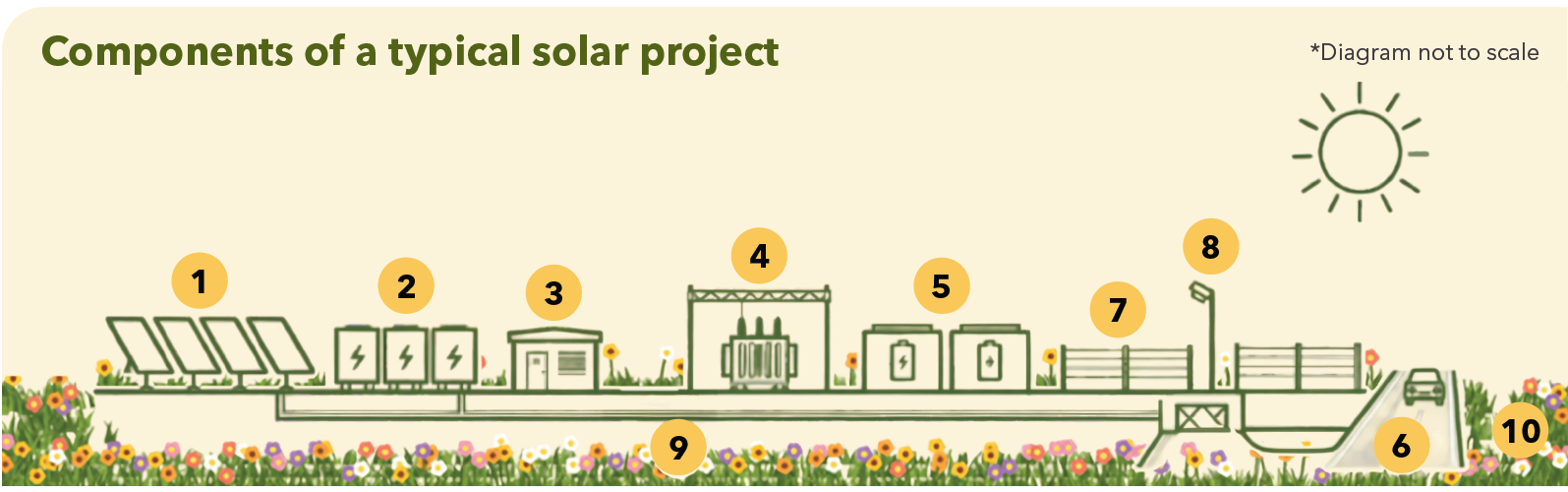
The Scheme
Solar arrays: Rows of panels on fixed or single-axis tracking (sun-following) frames
Conversion units: Inverters and transformers that convert and manage the power
Sub-distribution switch rooms: Small buildings housing electrical switchgear
Substations: 132 kV and 400 kV substations connecting the Scheme to the national grid
Battery Energy Storage System (BESS): Stores electricity and releases when it’s needed
Access: Site entrances from the public highway and highway improvement areas. For example, the provision of passing places.
Fencing and security: Deer-style fencing around the solar areas. Metal security fencing around the battery and substation areas
Lighting: None in the solar areas. Motion-activated security lighting only around the BESS and substation areas
Cabling: Buried cables within the sites and along a cable route to the existing National Grid Thornton Substation
Landscape and wildlife areas: Grassland beneath the panels, wildflower margins and other habitat areas
A full technical description of the Scheme is set out in the IER Volume 1, Chapter 3: The Scheme.
-
The environment is at the heart of what we do. The design of Humberhead Solar is environment-led, meaning that, where practicable, we will seek to protect and enhance the natural and human environment. Infrastructure will be sensitively sited and designed to minimise effects on the surroundings of the Scheme, while identifying opportunities for enhancement.
The ongoing design is being informed by a range of surveys and environmental work, which have helped identify environmental constraints and opportunities. Humberhead Solar will seek to deliver a measurable net gain for biodiversity by creating and enhancing habitats for local wildlife and managing grassland to enhance ecological value.
-
Scoping Report: Published in May 2026, the Scoping Report describes the Scheme and the proposed survey and assessment methodology from which an Environmental Impact Assessment can be undertaken for relevant environmental topics. The Planning Inspectorate’s Scoping Opinion, issued on 6 July 2026, provided further advice on the methodology and assessment criteria to be considered in the Environmental Statement.
Interim Environmental Report (IER): Published at the start of the public consultation in November 2026, the IER builds on the Scoping Report. It sets out baseline environmental conditions and the proposed assessment methodology, including how we will assess cumulative effects.
Environmental Statement: Submitted with the Development Consent Order application, currently anticipated in August 2027, this will build on the IER by taking account of further survey results. It will present our full assessment of the likely significant environmental effects of the Scheme.
Design principles
-
IGP has developed a series of company-wide design principles, which provide a framework for all of its projects, including Humberhead Solar. They aim to deliver benefits to communities, enhance biodiversity and help tackle climate change by harnessing and storing renewable energy, while seeking to minimise adverse effects on the local environment throughout the project’s lifecycle, from construction through to operation, maintenance and decommissioning.
-
We have developed a series of Scheme-specific design principles to provide a framework for embedding good design at the pre-application stage. These have been informed by environmental survey work and key issues identified by the project team since the project began. They influenced the design presented in this consultation and will continue to inform the design for the DCO application.
| National Infrastructure Commission (NIC) Design Principles | Theme | Scheme-specific design principle |
|---|---|---|
| Climate | Flexibility and climate change | We will keep the Scheme design flexible to allow it to adapt over time to new technological advancements and a changing climate, including building in resilience against extreme weather events as far as practicable. |
| Water environment | Our Scheme design will aim to ensure that the risk of flooding is not increased elsewhere. We will also aim to ensure that the Scheme itself is resilient to current and future flooding risks and adheres to good pollution control practice. | |
| People | Access | Our Scheme will deliver suitable accesses to allow for the safe construction and operation of the Scheme, including local highway improvements where appropriate and practicable. |
| Amenity | Our Scheme will minimise impacts on amenity where practicable, through the inclusion of embedded mitigation within the Scheme design including design parameters to address impacts to sensitive receptors. The Scheme design will include specific mitigation, if required and practicable. | |
| Place | Environment-led design | The Scheme design will be ‘Environment Led’, meaning that where practicable we will seek to protect and enhance the natural and human environment through design. We will aim to site infrastructure sensitively and design it to minimise effects on the natural and physical surroundings of the Scheme, while identifying opportunities for enhancement where practicable. |
| Mitigation hierarchy | We will follow the mitigation hierarchy, meaning our main goal will be to avoid impacts where practicable. Where impacts cannot be avoided, through the design process, these impacts will then be (where practicable) reduced, mitigated and compensated for. | |
| Cumulative developments | Our Scheme will adopt a sensitive and responsive design approach to minimise, where practicable, its contribution to cumulative effects arising in combination with other major developments in East Riding. | |
| Heritage | Our Scheme design will include set-backs, buffers and screening in appropriate locations so that it preserves the setting of designated heritage assets where practicable. The design of the Scheme will also consider below ground heritage assets. | |
| National Landscape | The Scheme will be designed sensitively in relation to the proposed Yorkshire Wolds National Landscape (YWNL), by seeking to further the purpose of the YWNL and to minimise effects on the designation where practicable. | |
| Value | Net Gain | We will deliver more than 10% net gain for biodiversity. This will be done by creating and enhancing habitats for local wildlife and managing grassland to maximise ecological value, where practicable. |
| Land use | Where practicable, we will be sensitive to existing land uses wherever possible and maximise opportunities to strengthen existing green infrastructure (terrestrial habitats) and blue infrastructure (water bodies / watercourses). This may include measures such as connecting isolated trees and filling in hedgerows. | |
| Recreation | We will aim to limit impacts on public rights of way, local recreation and access where practicable. The Scheme will seek to identify and deliver opportunities, where practicable, to improve existing routes and to create new permissive access. |
Key considerations
-
Humberhead Solar is being designed with consideration for the character of the surrounding countryside and the views experienced by local communities, residents and visitors including those using local roads and Public Rights of Way.
The landscape around the Humberhead Sites is predominantly rural and agricultural, with fields generally enclosed by hedgerows, trees and areas of woodland. These features provide visual structure and, in many locations, filter or restrict views across the landscape.
The Indicative Masterplan has been informed by landscape and visual assessment work to date. The relationship between Humberhead Site 2 and the proposed Yorkshire Wolds National Landscape is an important consideration. The proposed National Landscape lies to the east of Humberhead Site 2, although none of the Humberhead Sites or CRSC are located within it. Views towards the Humberhead Sites from higher ground within the Wolds are being considered as part of the assessment work.
Where appropriate, measures such as new planting, landscaping and screening are being considered to help integrate the project into its surroundings. Areas within the Humberhead Sites will also be used for landscaping and biodiversity mitigation and enhancement.
As the proposals develop, the findings of our landscape and visual assessments will help guide refinements to the Scheme design. We are continuing to engage with organisations including Natural England and East Riding of Yorkshire Council’s (ERYC) landscape consultant to inform the ongoing assessment and development of the Scheme.
-
The area surrounding the Scheme includes a number of important ecological features. These include the Pocklington Canal Site of Special Scientific Interest (SSSI), South Cliffe Common SSSI and White Carr Meadow SSSI, as well as other non-statutory sites and priority habitats. In addition, the Lower Derwent Valley and Humber Estuary Special Areas of Conservation, Special Protection Areas and Ramsar Sites lie to the west and south respectively.
Detailed surveys have been carried out, and are continuing, to identify wildlife and habitats present within the Sites, including seasonal surveys to understand the activity of species that could be affected by the Scheme.
The Indicative Masterplan seeks to avoid impacts where practicable and to provide mitigation. Potential effects are being assessed as part of the Environmental Impact Assessment.
Survey findings to date are available in the IER and have informed the design of Humberhead Solar.
General mitigation principles include:
Reinforce existing hedgerows throughout the Humberhead Sites by gapping up and implementing new native tree planting to reinforce landscape fabric.
Maintain existing and proposed hedgerows up to a maximum of 4.5m where appropriate and practicable.
Reinforce the existing blue and green infrastructure network and improve and create habitat connections where appropriate and practicable.
Reinforce and create layers of trees and hedgerows across the Humberhead Sites where appropriate and practicable.
We are continuing to engage with organisations including Natural England and ERYC’s ecologist to inform the ongoing ecological assessment and development of the Scheme.
Protecting and enhancing the environment is an important part of the design of Humberhead Solar. Alongside avoiding and mitigating impacts, the Scheme will deliver a range of environmental benefits through habitat creation and enhancement, and aims to deliver a measurable net gain for biodiversity alongside good land management practices.
-
We are undertaking environmental surveys and assessments to better understand existing drainage, watercourses and flood risk across the Humberhead Sites.
There are numerous watercourses and drainage features which are located within or around the Sites. These include Bielby Beck, Pocklington Beck, the River Foulness, Market Weighton Canal and a number of local drains, ditches, ponds and smaller watercourses.
The design has taken into account flood risk, existing drainage patterns and watercourses when considering the location of solar panels, substations, BESS infrastructure and other development.
Measures will be incorporated where required to manage surface water, maintain drainage and reduce the potential for changes to water flows.
We are continuing to engage with organisations including the Environment Agency, ERYC and the relevant Internal Drainage Boards to inform the ongoing assessment and design.
An interim Flood Risk Assessment (FRA) and drainage strategy forms part of the IER and will be developed further for the application for development consent.
-
We recognise that the historic environment is an important part of the character and identity of the area around Humberhead Solar.
Understanding where archaeological remains are present, and how the Scheme may affect the setting of historic buildings and other heritage assets, is therefore an important part of developing this project.
We have undertaken archaeological and heritage surveys to understand the historic environment within and around the Humberhead Sites. Archaeological investigations, including surveys and trial trenching, have helped identify areas of archaeological potential, and the results will inform the development of appropriate archaeological mitigation measures. The Environmental Impact Assessment will assess the potential impacts on heritage, taking account of mitigation.
The Indicative Masterplan includes set-backs, buffers and landscaping to minimise impacts on the setting of heritage assets, and heritage has been taken into account in siting the substations and the BESS.
We are continuing to engage with organisations including Historic England and ERYC’s archaeologist and Built Environment Manager to inform the ongoing assessment and development of the Scheme.
-
While Humberhead Solar would generate very little traffic once operational, construction traffic and access are key considerations and we recognise the importance of managing potential impacts on local roads and communities.
We are assessing the local road network so that construction deliveries, workers and other vehicle movements can be managed safely and efficiently. This work has informed the project’s Interim Transport Assessment, Interim Construction Traffic Management Plan and indicative construction traffic measures presented within the IER.
We are working closely with ERYC, National Highways, landowners and other relevant stakeholders to develop appropriate access arrangements and construction traffic measures. The draft outline Construction Traffic Management Plan will be developed further to set out how construction traffic will be managed. This will expand consideration of vehicle routing, delivery arrangements, timing and other measures to minimise disruption and maintain road safety.
Public Rights of Way (PRoW), including footpaths and bridleways, are an important part of the local area. The Scheme would seek to keep these routes open and accessible where practicable. Where construction may cause disruption, temporary measures such as diversions or short-term closures would be managed to protect the safety of and accessibility for users.
Humberhead Solar would also create new permissive paths to help improve public access in the local area. We would welcome your views on where new routes would be most valuable.
-
We are aware that a number of other energy projects are being developed or have been consented in the wider area. In particular, we recognise the proximity of the consented East Yorkshire Solar Farm and the proposed Mylen Leah Solar Farm, which is being brought forward by Statkraft. These are separate developments and are not connected to Humberhead Solar.
We understand that local residents may be concerned about the potential cumulative effects of several solar and other major developments in the area, and we recognise the importance of considering these as part of the environmental assessment. Our assessment will consider other relevant projects alongside Humberhead Solar, including their location, scale and timing, and whether their construction or operation could overlap with ours. This will take account of developments that are already part of the existing environment, as well as those that are planned or under construction. The approach to assessing potential cumulative or in-combination effects is set out in the IER.
Where potential cumulative or in-combination effects are identified, we will consider measures to avoid or reduce them and, where necessary, identify appropriate monitoring arrangements.
We are committed to engaging with other developers, including Statkraft, to help ensure residents are informed about each of the proposals in the area and, where practicable, to reduce disruption to the local community.
Indicative masterplans
A Focus on Community
We are committed to ensuring that communities benefit from Humberhead Solar including through direct funding to important causes in the local area.
As part of this consultation, we are seeking feedback on community benefits and how best to distribute funding. We would value your suggestions on any on-site and off-site initiatives we could bring forward as part of the project. You can provide your suggestions via our Feedback Form, or in writing by email or post.
The project would create jobs and supply chain opportunities, particularly during construction, and will be supported by a Skills, Supply Chain and Employment Plan to maximise opportunities for local recruitment and procurement.
Humberhead Solar will also deliver environmental benefits, including habitat creation and enhancement measures, contributing a measurable net gain for biodiversity alongside good land management practices. We would also provide permissive paths and other measures that could improve public access and enjoyment of the area.
The project would generate business rates revenue for the local area, on land that is currently exempt. Further details on the economic, social and environmental impacts of Humberhead Solar, including opportunities for additional local benefits, will be shared during the consultation and as the project develops.
Project timeline
March – April 2026
Early engagement starts with Council, local representatives, landowners, near neighbours
May – June 2026
Environmental Impact Assessment Scoping
June – September 2026
Archaeology surveys including trenches
January – February 2027
Analysis of consultation responses
March – July 2027
Preparation of DCO application
August 2027
Submission of DCO application
January - June/July 2028
Examination of the DCO application by the Planning Inspectorate
December 2028/January 2029
Anticipated decision on the DCO application from the Secretary of State
Late 2029 - Late 2031
(if consent given)
Indicative 12-24 month construction period
October 2031
(if consent given)
Operational
Have your say
We have carried out early engagement with ERYC, technical bodies, local representatives, landowners, and near neighbours on the project.
Our public consultation for Humberhead Solar runs from 16 November to 20 December 2026. It will allow those with an interest in the project to register their opinions and have their say on the project and its development.
If you have any questions or require any assistance with providing feedback, please contact the team by email - info@humberheadsolar.co.uk or phone - 020 3576 3469. Our phone lines and email are monitored between 09:00 and 17:00 on weekdays and we will aim to respond to you as soon as possible.
Upon agreement, the team can transcribe and agree feedback by phone.
The deadline to submit all feedback is at 23:59 on Sunday 20 December 2026.
Come and meet our team at one of our community information events. These events are an opportunity to find out more information about our proposals, discuss them in person with members of the project team and provide your feedback.
We want to hear any views you may have on the Project. You can respond to this consultation by:
Submitting written feedback via our online form.
Completing a paper feedback form at one of our community events, or request one from the project team.
Writing to us at Freepost HUMBERHEAD SOLAR (no stamp or further address details required).
Emailing us at info@humberheadsolar.co.uk.
Notes
*Based on estimated MW capacity and annual generation of the Scheme and average electricity consumption in the Yorkshire and The Humber. Source: DESNZ, Subnational Electricity Consumption Data (local authority and regional electricity consumption statistics) https://www.gov.uk/government/collections/sub-national-electricity-consumption-data and https://www.ons.gov.uk/datasets/TS017/editions/2021/versions/2
**National Policy Statement EN-1 https://www.gov.uk/government/publications/overarching-national-policy-statement-for-energy-en-1-2025/overarching-national-policy-statement-for-energy-en-1-2025-accessible-webpage and EN-3 https://www.gov.uk/government/publications/national-policy-statement-for-renewable-energy-infrastructure-en-3-2025
***Source: DESNZ, Electricity Generation Costs 2025 (January 2026), levelised cost of electricity (LCOE) estimates for new generation projects.